

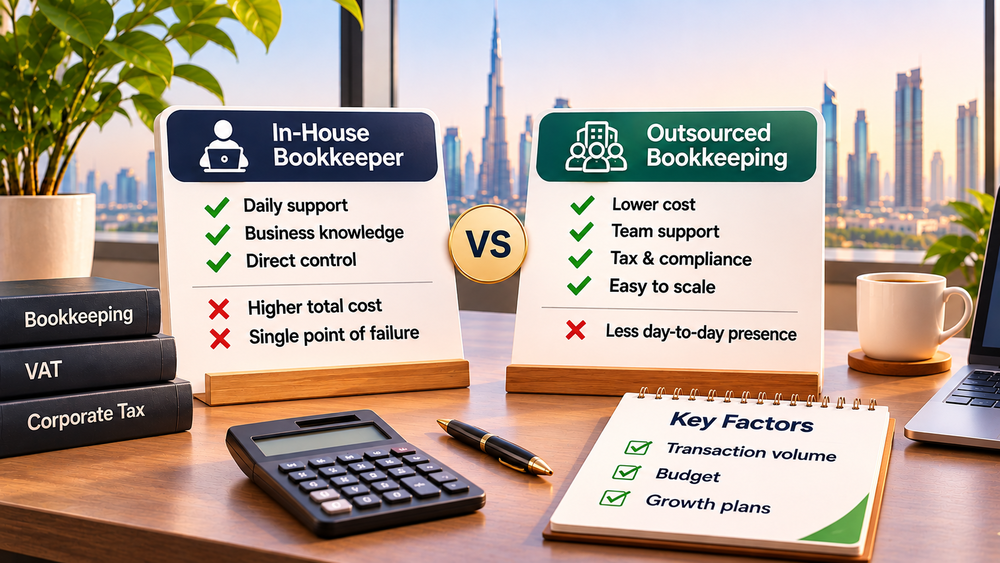
Every business needs accurate books. The real question is who should keep them. Some owners hire a full-time bookkeeper. Others use bookkeeping services Dubai firms provide on a monthly basis. Both options can work, but they suit different businesses at different stages.
This blog compares the two side by side. It looks at cost, control, skills, risk and growth, so you can make the choice that fits your company today and next year.
What a Bookkeeper Actually Does
Before comparing options, it helps to be clear about the job. A bookkeeper keeps a daily record of the money moving in and out of your business. That usually includes:
- Entering sales invoices and supplier bills
- Recording expenses and petty cash
- Reconciling bank accounts every month
- Keeping tax invoices in order for VAT
- Preparing basic reports for the owner or accountant
Good bookkeeping is the base for everything else. VAT returns, corporate tax returns, audits and bank loans all depend on it.
The Case for an In-House Bookkeeper
An in-house bookkeeper sits in your office and works only for you. This has clear benefits.
Benefits
- Daily presence. They can collect receipts, speak to staff and handle small tasks on the spot.
- Deep business knowledge. Over time, they learn your customers, suppliers and habits.
- Direct control. You decide their priorities each day.
Drawbacks
- Full cost of employment. Salary is only one part. You also pay for a visa, medical insurance, end-of-service gratuity, leave, a desk and software.
- Single point of failure. If they resign, fall sick or go on leave, your books stop.
- Limited skills. One person rarely knows bookkeeping, VAT, corporate tax and reporting equally well.
- No built-in review. Mistakes can go unnoticed until an audit or an FTA query.
In-house works best for larger companies with high transaction volumes and a finance manager who can supervise the work.
The Case for Outsourced Bookkeeping
With outsourcing, a specialist firm handles your books remotely or with scheduled visits. You share documents through cloud software or a secure folder.
Benefits
- Lower, predictable cost. You pay a monthly fee with no visa, gratuity or leave costs.
- A team, not one person. Work continues when someone is on leave.
- Built-in checks. A senior accountant usually reviews the work before it reaches you.
- Tax knowledge included. Firms that handle VAT and corporate tax understand how daily entries affect your returns.
- Easy to scale. As your business grows, the service grows with it.
Drawbacks
- Less day-to-day presence. You need a simple system for sending receipts and invoices.
- Shared attention. The firm serves other clients, so agree on response times upfront.
Outsourcing suits most startups and SMEs, especially those with fewer than a few hundred transactions a month.
A Quick Side-by-Side Comparison
|
Factor |
In-House Bookkeeper |
Outsourced Bookkeeping |
|---|---|---|
|
Monthly cost |
Salary plus visa, insurance, gratuity and leave |
Fixed monthly fee |
|
Cover during leave |
None unless you hire backup |
Team covers the work |
|
Tax knowledge |
Depends on the person |
Usually included |
|
Review of work |
Needs a manager |
Senior review built in |
|
Scaling up |
Hire more staff |
Upgrade the package |
Questions to Ask Before You Decide
Use these questions to test which model fits you:
- How many invoices, bills and bank transactions do you have each month?
- Do you have someone senior who can check a bookkeeper's work?
- How much time do you spend fixing errors before VAT filing?
- Will your business grow quickly in the next 12 months?
- Are you ready for e-invoicing, which needs structured and accurate data?
If you have low to medium volume and no finance manager, outsourcing is usually the safer and cheaper route. If you have very high volume and a strong finance lead, in-house staff may make sense.
The Hybrid Option
Some businesses use both. An in-house admin person collects documents and handles small entries. An outside firm reviews the books, closes each month and prepares tax returns. This gives you daily presence plus expert checks, without the cost of a full finance team.
For example, a restaurant with two outlets may have a cashier record daily sale, while an outsourced team reconciles bank accounts, posts supplier bills and files VAT each quarter.
Conclusion
There is no single right answer. The best choice depends on your volume, budget and internal skills. For most growing SMEs, outsourced bookkeeping services Dubai providers offer lower cost, better cover and stronger tax knowledge. Larger firms with finance managers may prefer in-house staff, or a mix of both. Amybizz offers monthly bookkeeping packages that include review and VAT support. Talk to the team to find the setup that fits your business.